Adjoints and The Spectral Theorem
Adjoints
For more details and exercises related to this material, see Chapter 10 of Roman’s Advanced Linear Algebra.
Suppose V and W are finite dimensional inner product spaces (over \mathbb{R} or \mathbb{C}). We will use the bracket notation \langle\cdot,\cdot\rangle for the inner products on both spaces. Let f:V\to W be a linear map.
Proposition: There is a unique linear map f^{*}:W\to V such that \langle f(v),w\rangle = \langle v,f^{*}(w)\rangle for all v\in V and w\in W. The map f^{*} is called the adjoint of f.
Proof: Let v_1, \ldots, v_n be an orthonormal basis for V and let w_1,\ldots, w_m be an orthonormal basis for W. If f^{*} exists, it must satisfy \langle f(v_{i}),w_{j}\rangle = \langle v_{i},f^{*}(w_j)\rangle for all 1\le i\le n and 1\le j\le m. So let’s define f^{*}(w_{j})=\sum_{i=1}^{n} a_{ij}v_{i} where a_{ij} = \overline{\langle f(v_{i}),w_{j}\rangle}.
This extends to a linear map W\to V by linearity and it’s clearly well-defined. In addition \begin{aligned} \langle v_k,f^{*}(w_{j})\rangle &= \sum_{i=1}^{n} \overline{a_{ij}}\langle v_{k},v_{i}\rangle \\ &=\overline{a_{kj}} \\ &=\langle f(v_{k}),w_{j}\rangle \end{aligned}
Both sides of \langle f(v),w\rangle = \langle v,f^{*}(w)\rangle are linear in v and conjugate-linear in w, so this identity on basis vectors extends to all v\in V and w\in W. This shows that f^{*} has the desired property. It is unique because the values f^{*}(w_j) were forced by the first display above.
It is possible to prove the existence of the adjoint without appealing to bases in this way; see Roman if you are interested in this.
One consequence of the computation in the proof is that if V=W and E is an orthonormal basis for V then [f^{*}]_{E} = \overline{[f]_{E}}^{\top}.
To check this, we compute:
\begin{aligned} \langle f(u),v\rangle &= ([f]_{E}[u]_{E})^{\top}\overline{[v]_{E}} \\ &= [u]_{E}^{\top}[f]_{E}^{\top}\overline{[v]_{E}}\\ &= [u]_{E}^{\top}\overline{\overline{[f]_{E}}^{\top}[v]_{E}}. \end{aligned}
So the linear map whose matrix is \overline{[f]_{E}}^{\top} satisfies the defining property of the adjoint, and by uniqueness of the adjoint, [f^{*}]_{E}=\overline{[f]_{E}}^{\top}.
The adjoint operation has the following properties.
- (f+g)^{*}=f^{*}+g^{*} and (af)^{*}=\overline{a}f^{*}.
- f^{**}=f.
- If V=W, then (fg)^{*}=g^{*}f^{*}.
- If f is invertible then (f^{-1})^{*}=(f^{*})^{-1}.
These all follow from the definition fairly easily. Let’s look at the third one. Assume V=W. Then \langle f(g(v)),w\rangle = \langle g(v),f^{*}(w) \rangle = \langle v,g^{*}f^{*}w\rangle
so (fg)^{*}=g^{*}f^{*}.
Adjoints and orthogonality
As before, let V and W be finite dimensional inner product spaces and let f:V\to W be a linear map. Then we have the following properties (from Roman, Advanced Linear Algebra, Theorem 10.3, page 202). Roman writes \tau for our f and \mathrm{im} for \mathrm{image}.
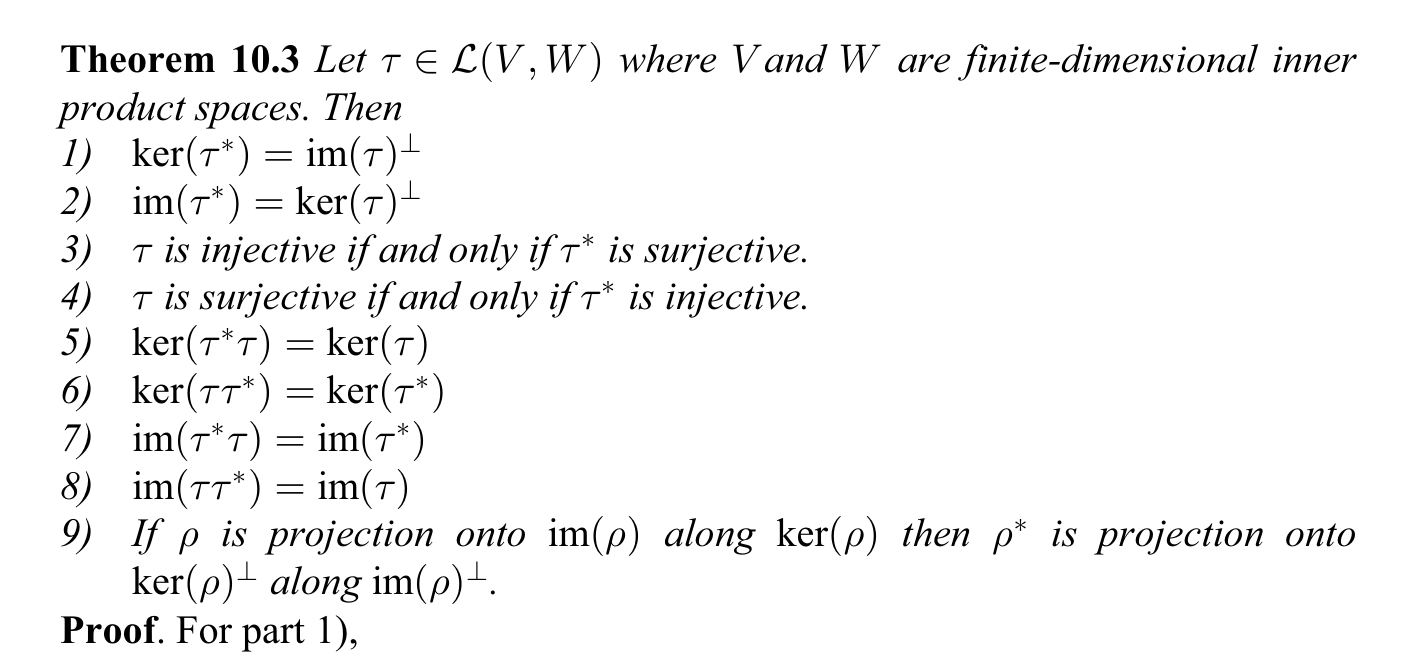
The proofs of these are applications of the definitions. Here are a few proofs.
1. \ker(f^{*})=\mathrm{image}(f)^{\perp}. Suppose w\in\ker(f^{*}). Then \langle v,f^{*}w\rangle=0 for all v. Thus \langle f(v),w \rangle is zero for all v, and therefore w is in \mathrm{image}(f)^{\perp}. Conversely, if w\in\mathrm{image}(f)^{\perp}, then \langle f(v),w\rangle=0 for all v, and then \langle v,f^{*}w\rangle=0 for all v. Since the inner product is definite, this means f^{*}w=0, i.e. w\in\ker(f^{*}).
3. f is injective if and only if f^{*} is surjective. Applying property 1 to f^{*} and using f^{**}=f gives \ker(f)=\mathrm{image}(f^{*})^{\perp}. If f is injective, then \mathrm{image}(f^{*})^{\perp}=\ker(f)=0 so \mathrm{image}(f^{*}) must be all of V. Conversely, if f^{*} is surjective then \ker(f)=V^{\perp}=0.
5. \ker(f^{*}f)=\ker(f). Clearly \ker(f^{*}f) contains \ker(f). On the other hand, if v\in \ker(f^{*}f), then \langle f^{*}fv,v\rangle=\langle fv,fv \rangle = 0 so f(v)=0.
Orthogonal and Unitary Diagonalizability
In this section, we will return to the question of diagonalizability in the setting of inner product spaces.
Definition: Let V be a (real or complex) inner product space of dimension n. A linear map f:V\to V is unitarily diagonalizable (or orthogonally diagonalizable in the real case) if there is an orthonormal basis for V consisting of eigenvectors for f.
Equivalently, f is unitarily diagonalizable if V can be written as a direct sum V = E(\lambda_1)\oplus E(\lambda_2)\oplus\cdots\oplus E(\lambda_k)
where the \lambda_j are distinct, each E(\lambda_j) is an eigenspace for f with eigenvalue \lambda_j, and E(\lambda_i)\perp E(\lambda_j) when j\ne i.
We would like to characterize unitarily diagonalizable matrices. Notice that if f is unitarily diagonalizable and E=\{u_1,\ldots, u_n\} is an orthonormal basis in which [f]_{E} is diagonal, and \lambda_j is the eigenvalue for u_{j}, then the matrix [f^{*}]_{E} of the adjoint f^{*} is also diagonal with diagonal entries \overline{\lambda_{j}}. As a result, [f]_{E} and [f^{*}]_{E} commute with one another, and therefore so do f and f^{*}.
Definition: A linear map f is called normal if ff^{*}=f^{*}f.
We will ultimately establish that, for complex vector spaces, the normal property characterizes unitarily diagonalizable maps. Over the real numbers the characterization of normal matrices is somewhat more complicated. See Roman, Theorem 10.19, page 247.
Proposition: Over \mathbb{C}, f is normal if and only if it is unitarily diagonalizable.
We will work our way up to this result. First, note that:
- the inverse of an invertible normal operator is normal
- if f is normal, so is f^2 (since (f^2)^{*}f^2=f^{*}f^{*}ff=fff^{*}f^{*}) and therefore so is any polynomial P(f) in f.
It is not the case in general that a sum or product of two normal operators is normal.
In addition, if f is normal:
- If f(v)=0 then f^{*}(v)=0. This holds because \langle f(v),f(v)\rangle=\langle v,f^{*}f(v)\rangle = \langle v,ff^{*}(v)\rangle = \langle f^{*}(v),f^{*}(v)\rangle.
- If f^{k}(v)=0 for k\ge 1 then f(v)=0. For this, let g=f^{*}f. The linear map g has the property that g^{*}=g; it is self-adjoint. Suppose g^{k}(v)=0 with k>1. Then \langle g^{k}(v), g^{k-2}(v)\rangle = \langle g^{k-1}v, g^{k-1}v\rangle =0 so g^{k-1}v=0. Inductively it follows that g(v)=0. Now if f^{k}(v)=0 for k>1, then, since f and f^{*} commute, g^{k}(v) = (f^{*})^{k}f^{k}(v)=0 so g(v)=0 so f^{*}f(v)=0 and finally \langle f(v), f(v)\rangle=0 so f(v)=0.
- The minimal polynomial of f acting on V is square free. This follows from the previous property applied to the normal map f-\lambda: if (f-\lambda)^{k}v=0 then (f-\lambda)v=0.
- If v is an eigenvector for f with eigenvalue \lambda, then v is an eigenvector for f^{*} with eigenvalue \overline{\lambda}. Apply the first property to the normal map f-\lambda, whose adjoint is f^{*}-\overline{\lambda}.
- Eigenvectors v and w with distinct eigenvalues \lambda and \mu are orthogonal. This holds because \langle f(v),w\rangle = \lambda \langle v,w\rangle = \langle v,f^{*}(w)\rangle = \langle v,\overline{\mu}w\rangle=\mu\langle v,w \rangle so if \mu and \lambda are different then \langle v,w\rangle=0.
Now we can show that, over the complex numbers, f is normal if and only if it is unitarily diagonalizable.
First, if f is unitarily diagonalizable, there is an orthonormal basis of V in which f is diagonal. In this basis, [f^{*}]=\overline{[f]} so clearly f and f^{*} commute. Conversely, by the results above, the minimal polynomial of a normal matrix is square free and factors over \mathbb{C} into linear factors. Therefore f is diagonalizable. In any fixed eigenspace we can choose an orthonormal basis, and since distinct eigenspaces are orthogonal these combine to give an orthonormal basis of eigenvectors for f.
Remark: Over \mathbb{R}, the minimal polynomial of a normal operator is square free (for an irreducible real quadratic q, apply the argument above to the normal operator q(f)), but it may not factor into linear factors – it factors into a combination of linear and degree two irreducible factors. From this factorization, V decomposes into a direct sum of eigenspaces (corresponding to the real eigenvalues) and subspaces whose minimal polynomial is of degree 2. One can say more about the factors corresponding to the degree two factors and from this obtain the full result. See Roman, Theorem 10.14, page 216.
Self-Adjoint Operators and Orthogonal Diagonalizability
Self-adjoint operators
There are two particularly important subclasses of normal operators for our purposes.
Definition: A linear map f is self-adjoint if f^{*}=f. Notice that a self-adjoint map is obviously normal.
When working with real vector spaces, self-adjoint operators are a more natural class than normal operators.
The class of self-adjoint operators is:
- closed under addition, multiplication by real numbers, inverses, and real polynomials.
We also remark that if [f] is the matrix of a linear map with respect to an orthonormal basis E=\{u_1,\ldots,u_n\}, then f is self-adjoint if and only if [f] is Hermitian, meaning that [f]^{\top}=\overline{[f]}. In particular over a real vector space [f] is symmetric. This is because [f]_{ij} = \langle f(u_{j}),u_{i}\rangle = \langle u_{j},f(u_{i})\rangle = \overline{\langle f(u_{i}),u_{j}\rangle} = \overline{[f]_{ji}}.
Proposition: If f is self-adjoint, then all of its eigenvalues are real.
Proof: We could argue that, if u is an eigenvector with eigenvalue \lambda, then \langle f(u),u\rangle = \lambda \langle u,u\rangle = \langle u, f(u)\rangle = \overline{\lambda}\langle u, u\rangle
so \lambda=\overline{\lambda}. Strictly speaking, however, if V is a real vector space, then we don’t know a priori that u is in V; it might have complex entries. We can work around this by choosing an orthonormal basis E for V and looking at the matrix [f]_{E}. Since f is self-adjoint, the matrix X=[f]_{E} is symmetric and we can think of it as a Hermitian matrix that happens to have real entries. The argument above shows that a Hermitian matrix has real eigenvalues, so its characteristic polynomial has only real roots. But the characteristic polynomial of X only depends on the entries of X, so the characteristic polynomial of f has only real roots.
Since self-adjoint matrices are normal, if we put this together with our results on normal matrices, we see that the minimal polynomial of a self-adjoint linear map f is square free and splits into linear factors over the real numbers (regardless of whether we’re in the complex or real case). Therefore we know that f is diagonalizable. And since we know that distinct eigenspaces are orthogonal, and we can find an orthonormal basis for each eigenspace, we have shown the following.
Proposition: Self-adjoint operators are orthogonally diagonalizable over \mathbb{R} (and conversely). Over \mathbb{C}, self-adjoint operators are unitarily diagonalizable with real eigenvalues (and conversely).
Unitary (or Orthogonal) Operators
A linear map f:V\to V is unitary (or, in the real case, orthogonal) if f is invertible and f^{*}=f^{-1}. Notice that this means that \langle f(v),f(w)\rangle = \langle v,f^{*}f(w)\rangle = \langle v,f^{-1}f(w)\rangle = \langle v,w\rangle
for all v,w\in V. So a unitary/orthogonal map preserves the inner product and also the norm \|v\|^2 = \langle v, v\rangle.
Proposition: Let f be a unitary linear map. Then:
- If u_1,\ldots, u_n is an orthonormal basis, then so is f(u_1),\ldots, f(u_n) and, conversely, if f carries one orthonormal basis to another it is unitary.
It’s clear from the definition that if u_1,\ldots, u_n is orthonormal, so is f(u_1),\ldots, f(u_n). Conversely suppose that f is any linear map and u_1,\ldots, u_n is an orthonormal basis. Suppose that f(u_1),\ldots, f(u_n) is orthonormal. Write v=\sum a_{i}u_{i} and w=\sum b_{i}u_{i} for two vectors v and w. Then \langle f(v),f(w)\rangle = \langle \sum a_{i}f(u_{i}),\sum b_{j}f(u_{j})\rangle = \sum_{i,j} a_{i}\overline{b_{j}}\delta_{ij}=\langle v,w\rangle so f is an isometry. Since f carries a basis to a basis, it is invertible, so f is unitary by the criterion for invertible isometries below.
- The eigenvalues of a unitary matrix have complex absolute value one. This is because if v is an eigenvector of f with eigenvalue \lambda then
\langle v,v\rangle = \langle f(v),f(v)\rangle = \lambda\overline{\lambda}\langle v,v\rangle
so \lambda\overline{\lambda}=1.
- Suppose that f is an invertible isometry, meaning that it is an invertible linear map and \langle f(v),f(w)\rangle = \langle v,w\rangle for all pairs of vectors v,w. Then f is unitary.
This is because \langle f(v), f(w)\rangle = \langle v, f^{*}f(w)\rangle = \langle v,w\rangle. This means f^{*}f(w)=w (since for any w, \langle v, f^{*}f(w)-w\rangle=0 for all v; taking v=f^{*}f(w)-w shows f^{*}f(w)-w=0.) But f^{*}f(w)=w means f^{*}=f^{-1} so f is unitary.
- Over the reals, f is orthogonal if and only if \|f(v)\|^2=\|v\|^2 for all v. This is because over the reals we have the “polarization identity”:
\langle v,w\rangle = \frac{1}{4}(\|v+w\|^2-\|v-w\|^2)
Proposition: A matrix A is unitary if and only if \overline{A}^{\top}A=I (over the reals, A^{\top}A=I). For unitary matrices:
- the rows (and columns) of A form an orthonormal set.
- the eigenvalues of a unitary (or orthogonal) matrix have complex absolute value 1.
- the determinant of A is of complex absolute value 1; over the reals, an orthogonal matrix has determinant \pm 1.
Orthogonal Projection and Spectral Resolution
A linear map L:V\to V is called a projection map if L^2=L. This implies that:
- the restriction of L to \mathrm{image}(L) is the identity.
- If v\in V, then L(v-Lv)=0 so v-Lv\in \ker(L) and every vector v=(v-Lv)+Lv\in \ker(L)+\mathrm{image}(L).
- If v\in \ker(L)\cap \mathrm{image}(L), then v=Lx=L^2x=Lv=0. In other words V=\ker(L)\oplus\mathrm{image}(L).
A projection is orthogonal if it is self-adjoint. This is equivalent to saying that \ker(L) and \mathrm{image}(L) are orthogonal. If L is a self-adjoint projection, x=Lu\in \mathrm{image}(L) and y\in\ker(L) then
\langle x, y\rangle = \langle Lu,y\rangle = \langle u,Ly\rangle =0.
Conversely, if \ker(L) and \mathrm{image}(L) are orthogonal write v=u+w and v'=u'+w' where u,u'\in\ker(L) and w=La, w'=La'\in \mathrm{image}(L). Then \langle Lv,v'\rangle = \langle Lw, u'+w'\rangle =\langle Lw, w'\rangle = \langle w, w'\rangle = \langle w, Lw'\rangle = \langle v, Lv'\rangle
If L is normal over \mathbb{C}, and V=E(\lambda_1)\oplus\cdots\oplus E(\lambda_{r}) is the orthogonal decomposition of V into L-eigenspaces, we can construct orthogonal projections p_{i} onto E(\lambda_{i}), with p_ip_j=0 for i\ne j and \sum p_i=I. Then L = \sum \lambda_{i}p_{i} is called the spectral resolution of L.
If L is self-adjoint over \mathbb{R} it has a similar resolution with real eigenvalues.
Proposition: The projection operators in the spectral resolution of a self-adjoint linear map L (over \mathbb{R}) or normal map L (over \mathbb{C}) are polynomials in L. In particular they commute with the linear map L.
In fact one can construct these operators p_{i} directly from the eigenvalues of L. Suppose \lambda_{1},\ldots, \lambda_{r} are the eigenvalues. Construct polynomials f_{1},\ldots,f_{r} where f_{i} takes the value 1 at \lambda_{i} and zero at the other \lambda_{j}. You can do this by setting f_{i}(x) = \frac{\prod_{j\not=i}(x-\lambda_{j})}{\prod_{j\not=i}(\lambda_{i}-\lambda_{j})}. Then f_{i}(L) is an operator whose eigenvalues are 1 and 0 and the 1-eigenvalues correspond to the eigenvalues \lambda_{i}. Since L is diagonalizable, f_i(L) acts on E(\lambda_j) as multiplication by f_i(\lambda_j), so f_i(L)=p_i.
Positivity
A self-adjoint linear map L:V\to V is called positive if Q_{L}(v) = \langle Lv, v\rangle \ge 0 for all v, and positive definite if the inequality is strict unless v=0.
Remark: Q_{L}(v) is real because \overline{\langle Lv, v\rangle} = \langle v, Lv\rangle = \langle Lv, v\rangle.
Proposition: L is positive if and only if all its eigenvalues are non-negative, and positive definite if and only if they are all strictly positive.