Week 2 Suggested Problems
Suggested Problems (suggested by Claude)
Let F be a field. Show that if x,y\in F and xy=0, then x=0 or y=0. (Hint: if x\not=0, multiply both sides by x^{-1}.) Where in this argument do you use the fact that F is a field rather than, say, the ring of integers modulo 6? What goes wrong in \mathbf{Z}/6\mathbf{Z}?
Let V be the space of differentiable real-valued functions on [0,1]. Show directly (without appealing to the general axioms for \mathbf{R}^n) that V is a vector space over \mathbf{R}, and explain why it is infinite dimensional.
Let V be the solution space of the differential equation f''-3f'+2f=0 over \mathbf{C}. Using the fact that this space is 2-dimensional, find a basis for V, and use it to write down an isomorphism \mathbf{C}^2\to V.
Let A be the matrix A = \begin{bmatrix} 1 & 2 & 1 & 0 \\ 2 & 4 & 0 & 1 \\ 1 & 2 & -1 & 1 \end{bmatrix} regarded as a linear map L:\mathbf{R}^4\to\mathbf{R}^3. Find bases for \mathrm{null}(L) and \mathrm{image}(L), and verify the rank-nullity formula \dim(\mathrm{null}(L))+\dim(\mathrm{image}(L))=\dim(\mathbf{R}^4).
In \mathbf{R}^4, let U=\mathrm{Span}\{(1,0,1,0),(0,1,0,1)\}, \qquad W=\mathrm{Span}\{(1,1,0,0),(0,0,1,1)\}. Find a basis for U+W and a basis for U\cap W, and check that \dim(U+W)=\dim(U)+\dim(W)-\dim(U\cap W). Is U+W a direct sum?
Let W=\{(x_1,x_2,x_3,x_4)\in\mathbf{R}^4 : x_1+x_2+x_3+x_4=0\}. Describe the quotient space \mathbf{R}^4/W explicitly, exhibit an isomorphism \mathbf{R}^4/W\to \mathbf{R}, and verify the dimension formula \dim(\mathbf{R}^4/W)=\dim(\mathbf{R}^4)-\dim(W).
Consider the complex of real vector spaces 0\to \mathbf{R} \xrightarrow{d_0} \mathbf{R}^3 \xrightarrow{d_1} \mathbf{R}^3 \xrightarrow{d_2} \mathbf{R} \to 0 where d_0(a)=(a,a,a), d_1(x,y,z)=(x-y,y-z,z-x), and d_2(x,y,z)=x+y+z. Check that d_1d_0=0 and d_2d_1=0, so this really is a complex. Compute H^0, H^1, H^2, and H^3, and verify that the Euler characteristic \chi=\sum(-1)^i\dim(W^i) agrees with \sum(-1)^i\dim H^i.
Suggested Problems (suggested by JT)
Let V be the space of differentiable real-valued functions on [0,1]. Let \partial be the derivative operator \partial(f) = f'. What is the null space of f? How is this proved?
Let X be the set of 4\times 4 real matrices, which we are going to think of as 4\times 4 (discrete) images; the entry X_{ij} is the B/W intensity of the image at that point. (Obviously in real life you would look at bigger matrices representing “real” images, but this is enough for the purpose of our example.)
An important “smoothing” operation in image processing converts X to a 2\times 2 matrix Y where Y_{ij} is average value of the 9 entries “surrounding” X_{i+1,j+1}. So for example Y_{11} is the average value of the 9 entries of X surrounding X_{22}.
Show that this map from 4\times 4 matrices to 2\times 2 matrices is linear. Can you choose reasonable bases for the domain and range, and describe the matrix of this smoothing map in those bases?
- Let G be a finite graph (i.e. a finite set of vertices V, and a finite set of edges E\subset V\times V where we think of an edge (v_1,v_2) as going from vertex v_1 to v_2. We require that, whenever (v_1,v_2) is an edge, so is (v_2,v_1).
For example:
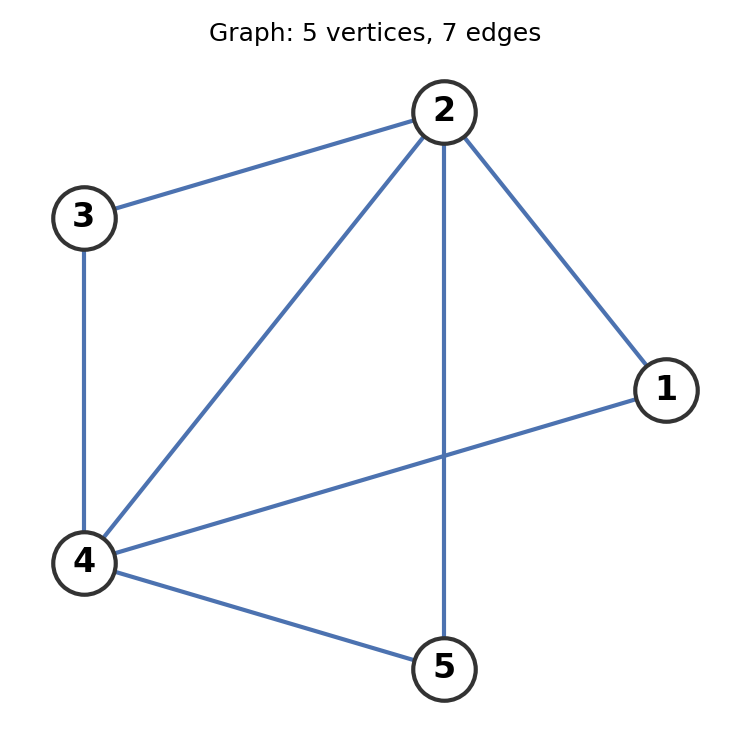
Now let V^{0} be the space of real-valued functions f:V\to \R and let V^{1} be the space of real functions f:E\to \R where f((v_1,v_2))=-f((v_2,v_1)).
Now define d:V^{0}\to V^{1} by d(f)((v_1,v_2))=f(v_1)-f(v_2).
and all other V^{j} are the zero vector space with zero maps. This is well-defined since d(f)((v_2,v_1))=f(v_2)-f(v_1)=-(f(v_1)-f(v_2))=-d(f)(v_1,v_2).
- Describe a basis for V^{0} and V^{1}.
- Describe the matrix of d in this basis.
- What is the Euler Characteristic of this complex?
- What does it measure about the graph?
- By definition, H^{0} of this complex is the kernel of d. Interpret the elements of H^{0} in terms of the graph. What is the dimension of H^{0}?
- By definition, H^{1} of this complex is the quotient V^{1}/B^{0} where B^{0} is the image of V^{0} in V^{1}. Interpret the elements of this quotient space in terms of the graph. What is the dimension of H^{1}?