Direct Proof
From page 122 of the text
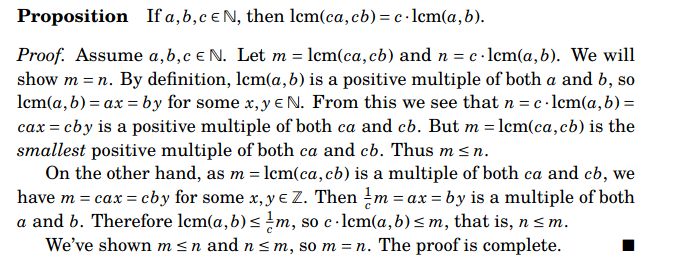
Take the proof of the proposition apart
Assume \(a,b,c\in\mathbb{N}\).
Let \(m=\mathrm{lcm}(ca,cb)\) and \(n=c\mathrm{lcm}(a,b)\). We will show that \(m=n\).
By definition, \(\mathrm{lcm}(a,b)\) is a positive multiple of both \(a\) and \(b\), so \(\mathrm{lcm}(a,b)=ax=by\) for some \(x\) and \(y\) in \(\mathbb{N}\).
From this we see that \(n=c\mathrm{lcm}(a,b)=cax=cby\) is a positive multiple of both \(ca\) and \(cb\). Thus \(m\le n\).
Taking the proof apart
On the other hand, as \(m=\mathrm{lcm}(ca,cb)\) is a multiple of both \(ca\) and \(cb\), we have \(m=cax=cby\) for some \(x,y\in\mathbb{Z}\).
Then \(\frac{1}{c}m=ax=by\) is a multiple of both \(a\) and \(b\).
Therefore \(\mathrm{lcm}(a,b)\le\frac{1}{c}m\) so \(c\mathrm{lcm}(a,b)\le m\), that is \(n\le m\).
Since \(m\le n\) and \(n\le m\), we have \(m=n\). The proof is complete.