Pairs of Quantifiers
Paired quantifiers \(\exists,\exists\)
- There exists \(x\in A\) so that there exists \(y\in B\) so that \(P(x,y)\)
There exists \(x\in\mathbb{N}\) so that there exists \(y\in\mathbb{N}\) so that \(x+y=5\).
\(\forall,\forall\)
- For all \(x\in A\) and for all \(x\in B\), \(P(x,y)\).
For all \(x\in\mathbb{N}\) and for all \(y\in\mathbb{N}\), \(xy>0\).
For all \(x\in\mathbb{Z}\) and for all \(y\in\mathbb{N}\), \(xy>0\).
\(\forall, \exists\)
- For all \(x\in A\) there exists \(y\in B\) so that \(P(x,y)\).
For all \(x\in\mathbb{N}\) there exists \(y\in\mathbb{N}\) so that \(2y=x\).
For all \(x\in\mathbb{Z}\) there exists \(y\in\mathbb{Q}\) so that \(2y=x\).
For all \(\epsilon\in\mathbb{R}\) with \(\epsilon>0\), there exists \(\delta\in\mathbb{R}\) with \(\delta>0\) so that \(x^2<\epsilon\) when \(x<\delta\).
\(\exists, \forall\)
- There exists \(x\in A\) so that for all \(y\in B\) we have \(P(x,y)\).
There exists \(x\in\mathbb{N}\) so that for all \(y\in\mathbb{N}\) we have \(xy>1\).
There exists \(x\in\mathbb{Q}\) so that for all \(y\in\mathbb{Q}\) we have \(xy<y\).
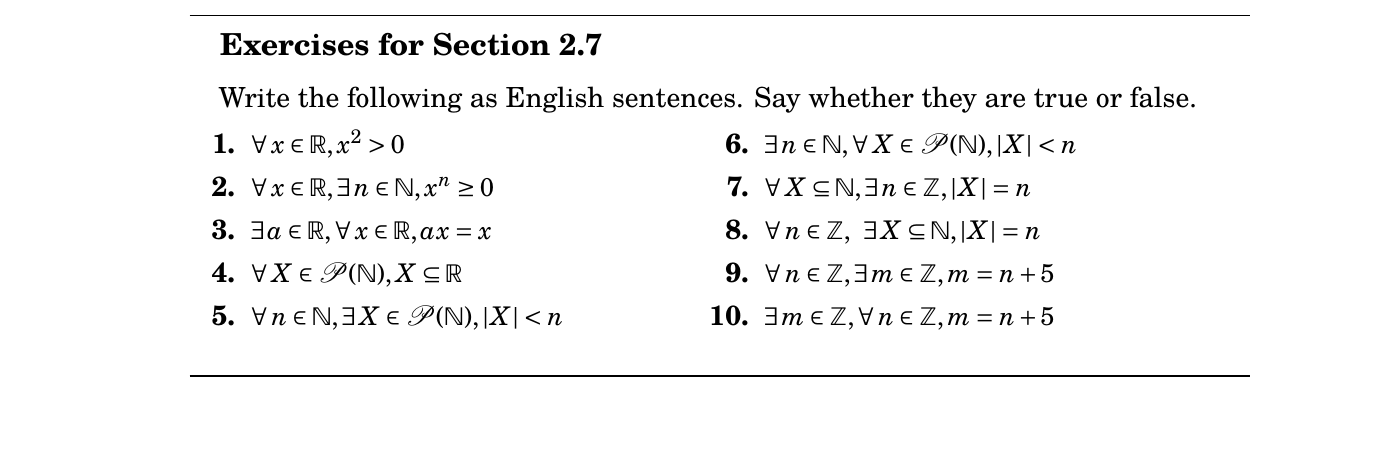
Exercises for Section 2.7